Lumosity: Brain Training Games
The most polished brain-trainer on Android — but you hit a hard paywall within days, and the science behind it is shakier than the marketing admits.
- People who want a well-made 10-minute daily habit with score and streak motivation
- Anyone who enjoys tightly-designed mini-games and doesn't mind paying for polish
- Anyone expecting measurable real-world IQ or memory gains — the evidence isn't there
- Budget users: the free tier is a demo and the annual plan is pricey
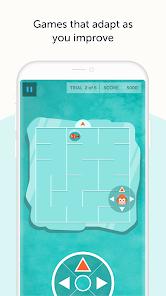
Overview
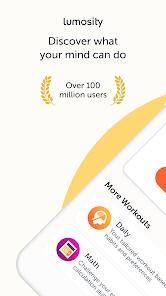
Lumosity is the app most people picture when they hear “brain training,” and the appeal is easy to see: the craft is genuinely high. The mini-games are smooth, the difficulty curve is well-tuned, and sessions are built to run just a few minutes — exactly the kind of low-friction habit that tends to survive past week one. With 10M+ installs and a 4.8-star average across roughly 282,000 ratings, it’s also the category’s default. But a high rating and real polish are not the same thing as the promise on the tin, and the honest review lives in the gap between them.
What the daily workout actually feels like
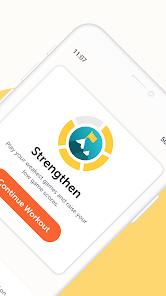
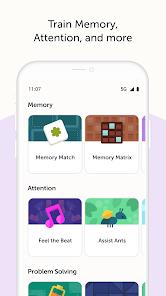
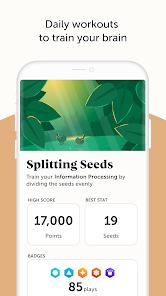
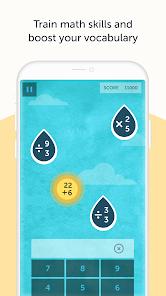
Open Lumosity and it funnels you into a short daily set: a handful of games chosen for you, each targeting a “cognitive area” like memory, attention, or problem-solving. The experience is deliberately frictionless — low-latency touch controls, clean visual layouts, and an adaptive engine that scales difficulty in real time to your accuracy and speed. Miss a few in a row and the app quietly eases off: it slows the pace, simplifies the layout, or drops the number of distractors to pull you back to a comfortable threshold. Nail them and it ramps up. That responsiveness is the best thing about Lumosity as a product — it’s the reason a session feels like a satisfying little test rather than a chore, and reviewers consistently praise the fluid performance and “polished presentation.”
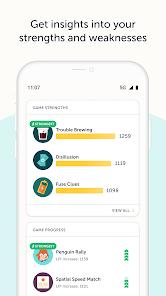
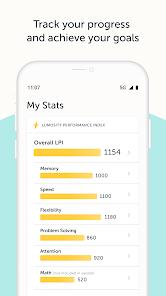
Wrapped around the games is the metrics layer, and this is what turns casual play into a habit. Everything feeds a single normalized score — the Lumosity Performance Index (LPI) — calculated from a weighted blend of speed and accuracy, calibrated against the baseline “Fit Test” you take on day one. You can watch your LPI trend over time and break it down by cognitive domain, and the more analytically minded users love it: the graphs “help pinpoint personal cognitive strengths and weaknesses,” as one reviewer put it. Rising numbers are moreish, and Lumosity engineers that loop expertly.
The two problems the marketing glosses over
Here’s where it gets complicated. The first problem is the gap between what Lumosity feels like and what it can actually prove. The daily scores climb, which feels like getting smarter — but the wider research on whether brain-training games transfer to real-world memory or focus is, at best, mixed, and Lumosity’s own FAQ quietly concedes the app “is not clinically proven as a standalone diagnostic or treatment tool.” That hedge matters, because Lumos Labs itself settled with the US Federal Trade Commission in 2016 over precisely these kinds of transfer claims, and nothing since has meaningfully changed the evidence base. Your LPI going up is real; it means you’re getting better at Lumosity’s games. Whether that carries into your actual life is the part no one can promise. Treat the numbers as motivation, not medicine.
The second problem is money, and it arrives fast. The free tier is effectively a demo: non-subscribers are limited to about three pre-selected games a day and locked out of the historical trends and analytical insights — which, given that the tracking is the hook, guts the experience within a couple of days of daily use. Reviewers voice this constantly; the most common complaint by far is that the free version “locks analytical insights and limits access to just three games per day.” And the subscription is priced at the top of the category, well above what you’d pay for a general utility app. That’s defensible given the production quality, but it means the real cost of the habit is high and the free trial is really a taster, not a usable product.
How it compares
Lumosity’s rivals — Peak, Elevate, NeuroNation and the rest — play the same game with the same unprovable transfer promise, so choosing between them is mostly about which interface and which mini-games you enjoy most. On pure polish and breadth of exercises, Lumosity is at or near the front; Elevate arguably edges it for language- and communication-focused drills. But the more useful comparison is to the free alternatives that make no grand claims at all: a daily crossword, a chess puzzle, a language app like Duolingo, or genuinely learning an instrument will all exercise your brain at least as legitimately, often for nothing. Lumosity’s edge is not better outcomes — it’s a more addictive, better-measured experience of practising.
Still actively maintained
One point in its favour: this isn’t abandonware dining out on old goodwill. The app is on version 10.20.2 with an update in April 2026, and the responsiveness and stability show that ongoing attention. Whatever you make of the science, you’re getting a well-maintained, technically excellent piece of software.
Onboarding: the Fit Test and what it measures
Your first session is the “Fit Test” — a short battery of games that establishes your baseline and, not coincidentally, hooks you. From it Lumosity seeds your starting Lumosity Performance Index and sorts your ability across cognitive domains like memory, attention, speed, flexibility, and problem-solving. Every daily workout afterwards is assembled to touch a spread of those areas, and your LPI is recalculated as a normalized, weighted blend of response speed and accuracy across everything you’ve played, always measured against that opening baseline. It’s a well-designed onboarding: within five minutes you have a number, a set of “weak” domains to improve, and a reason to come back tomorrow.
The domain breakdown is more than window dressing for the analytically minded. Because your LPI splits by area, you can actually see whether your attention scores lag your memory scores, and the app steers your workouts accordingly — the same reviewers who love the graphs use exactly this to “pinpoint personal cognitive strengths and weaknesses.” Whether improving a domain score improves the underlying ability is the open question from earlier, but as a self-consistent measurement system it’s genuinely satisfying to engage with.
One practical wrinkle to plan around: Lumosity mostly wants a connection. It needs the internet to load the daily workout, sync your metrics, and update its data, though some games are cached and will run offline. So it’s not a reliable seat-back-on-a-plane app the way a downloaded puzzle game is — if you were counting on brain training for a long flight with no wifi, check what’s cached first.
Put together, the onboarding and metrics are the real product here. The individual games are pleasant but not unique; what keeps people coming back is the sense of a personalized system watching your numbers and adjusting. That’s superb retention design. Just remember it’s retention design — the loop is engineered to be sticky, which is a separate thing from being good for you.
The verdict
Judged as a well-built daily habit, Lumosity is a yes — with caveats. The craft is real, the adaptive difficulty is genuinely clever, and the LPI loop is motivating in the way a good fitness tracker is motivating. If you enjoy the mini-games for their own sake and you don’t mind paying a premium for a polished experience, you’ll get your few minutes of daily satisfaction and no harm done. But go in clear-eyed on both fronts: the honest recommendation depends entirely on why you’re here. As a fun, tightly-designed daily brain-teaser, it’s worth a look. As a way to measurably get smarter or hold off cognitive decline, the evidence isn’t there — and at Lumosity’s prices, that distinction is the whole ballgame.
How We Evaluate
We score every app on the same checklist: onboarding friction, how hard it paywalls core value, day-2 retention hooks, and whether its marketing claims hold up. For Lumosity we read widely across recent Play Store reviews, the changelog history, and the published research record on "brain training" transfer effects.
Pros & Cons
Uses a scientifically grounded curriculum designed in collaboration with global academic researchers.
Employs highly responsive, real-time adaptive difficulty scaling based on user accuracy and speed.
Provides comprehensive progress tracking using the Lumosity Performance Index (LPI).
Features an intuitive, low-latency interface that minimizes mechanical friction during speed tasks.
Includes diverse mini-game mechanics to prevent repetitive task fatigue.
- ✕
The free tier is highly restrictive, locking advanced games and historical trends behind a paywall.
- ✕
The subscription pricing is relatively high compared to general utility apps.
- ✕
The long-term transfer of in-game performance gains to real-world cognitive tasks lacks definitive clinical proof.
Download
 Get it on Google Play
  Get it on App Store
 FAQs
How does Lumosity calculate the Lumosity Performance Index (LPI)?
The LPI is a normalized statistical score calculated using a weighted combination of response speed and accuracy across all completed games, calibrated against a baseline established during the Fit Test.
Can Lumosity prevent or reverse clinical cognitive decline?
While studies suggest that cognitive training supports cognitive reserve, the app is not clinically proven as a standalone diagnostic or treatment tool for neurodegenerative diseases.
Is an active internet connection required to play Lumosity games?
The application requires an internet connection to load the daily workout, sync performance metrics, and update demographic data, though some cached games can run offline.
How does the adaptive progression system handle consecutive errors?
When consecutive errors are recorded, the app's algorithms reduce game speed, simplify visual layouts, or decrease the number of distractors to bring the user back to a comfortable performance threshold.
Hot Reviews
Users appreciate the detailed graphs and metrics, noting that tracking LPI performance across individual cognitive domains helps pinpoint personal cognitive strengths and weaknesses.
Many non-subscribing users express frustration with the free tier, noting that it locks analytical insights and limits access to just three pre-selected games per day.
Reviews frequently highlight the high visual quality and responsive touch controls, which help prevent frustration during high-speed attention and coordination challenges.