
MISTPLAY: Play to Earn Money
Yes, it genuinely pays — real gift cards, not a scam. But do the math before you get excited: you're earning roughly $0.50–$1.50 an hour, your battery takes a beating, and one overzealous fraud flag can wipe everything you've banked.
- People who already sink hours into casual mobile games and want a small bonus for time they'd spend anyway
- Patient users happy to treat a $10 gift card every few weeks as found money, not income
- Anyone hoping to earn a meaningful hourly rate — the effective wage is far below minimum
- Owners of mid-range phones who care about battery life and heat, or anyone who'd be furious losing banked points to an automated ban


Overview
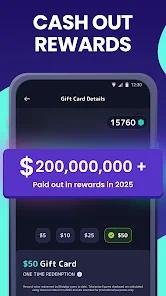
Let’s answer the only question that matters first: yes, Mistplay actually pays. Play the games it lists, earn “units,” and cash those units out for real Amazon, PayPal, or Visa gift cards — with redemption thresholds starting as low as $0.50 and codes typically landing in your inbox within 48 hours. Reviewers confirm it again and again: the app “performs exactly as advertised.” So this isn’t one of the fake reward apps that dangles a payout you can never reach. The catch isn’t whether it pays. The catch is what it pays, and what it costs you to get there.
How the machine works
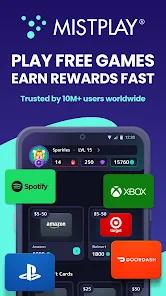
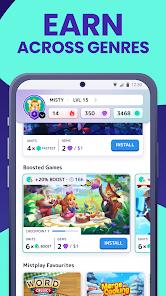
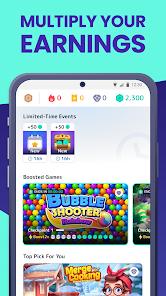
Mistplay is a discovery engine dressed up as a game launcher. It shows you a catalogue of hundreds of mobile games across genres — strategy, puzzle, RPG — and when you install and play one through Mistplay, a background overlay uses your phone’s usage-access permission to track exactly how long that game is active on screen. Hit playtime and in-game milestones and you accrue units, which convert to gift cards. A gamified layer of profile levels, daily login streaks, and achievement badges sits on top to keep you coming back, and it’s genuinely well made — the loop is sticky in the way a good loyalty program is sticky.
The reason any of this exists is programmatic user acquisition: game developers pay Mistplay a premium to find high-value players, and Mistplay hands a slice of that marketing budget back to you. That’s a legitimate model — but it also caps how much can ever flow in your direction, and it quietly explains every frustration below.
The math nobody puts in the ad
Once you convert units into an hourly rate, the picture gets sober fast. By the accounts of the people actually grinding it, active playtime returns something like $0.50 to $1.50 an hour. Read that again before you plan around it. This is beer-money-for-time-you’d-waste-anyway territory, not a side hustle.
Worse, the rate doesn’t hold. Earning is front-loaded: the first week in any given game pays briskly, then the multiplier decelerates hard — reviewers describe point accumulation “grinding to a near halt” once a game passes around level 15. That’s by design, because Mistplay gets paid for new installs, not your loyalty, so the system actively nudges you to abandon a game you’ve invested in and start a fresh one. The honest experience is a treadmill: chase the fast early rates, hit the wall, rotate, repeat. And titles sometimes vanish from the catalogue entirely — one reviewer watched “high-progress games occasionally vanish without warning, wiping out potential rewards.”
The costs that don’t show up as costs
Because Mistplay has to watch how long you play, that background overlay runs constantly — and it’s heavy. Users on mid-tier phones report a full battery drained in under two hours and “noticeable thermal pressure” when Mistplay is tracking on top of a graphically demanding game. It also eats storage, since the whole point is to keep installing new titles. If your phone already runs warm, this will make it worse, and the electricity and battery wear are a real if invisible tax on those $0.50 hours.
Then there’s the fraud system, and this is the one that turns a mild “meh” into a genuine warning. To stop bot farms, Mistplay requires a facial-verification scan before your first cash-out and runs aggressive anti-cheat detection against emulators, VPNs, and multi-accounting. Fair enough in principle — but reviewers report the algorithms are trigger-happy, flagging legitimate accounts as fraudulent, suspending them, and deleting accumulated points with “very limited options for appeal.” When the currency is your own banked hours, an unaccountable automated ban isn’t a minor risk; it’s the risk. Using a VPN for any reason will get you banned outright, and which games and payout channels you even see depends heavily on what country you’re in.
How it compares
Within the play-to-earn genre, Mistplay is the biggest and among the most legitimate — it pays more reliably than the swarm of knock-off reward apps, and unlike many it never demands an up-front purchase. If you’re set on a rewards-for-gaming app, this is the sensible default. But the more honest comparison is to how else you could spend that time. A few hours a week of focused effort at almost any real task clears Mistplay’s effective wage many times over; even a cashback or survey app tends to pay better per minute of attention. Mistplay only makes sense when the time was going to be “wasted” on casual gaming regardless — as a skim off leisure you’d take anyway, not as a use of time you’d otherwise value.
A worked example, and the scale behind it
Put real numbers on it. Say you play a couple of hours most evenings — call it 12 hours across a week. At Mistplay’s typical $0.50–$1.50 hourly range, front-loaded because you’re on fresh games, that’s maybe $10–$15 in gift cards for the week, and less the week after as those games hit their level-15 wall and the rate sags. Redeem early — a $5 or $10 Amazon code — and it arrives within about 48 hours. That’s the honest shape of it: a slow, steady trickle of small gift cards, not a balance that ever grows into real money.
It helps to understand the scale that makes this possible. Mistplay has been around since 2016 and runs one of the largest loyalty platforms of its kind, with installs north of 50 million, which is exactly why developers pay it enough to fund any payout at all. That scale is the reassuring part — this is an established operation with genuine budgets behind it, not a fly-by-night that vanishes with your points.
The uncomfortable part is what protecting that operation means for you. The face-verification scan before your first cash-out, the outright VPN ban, the emulator and multi-account detection — all of it exists to keep bot farms out, and all of it occasionally catches real people. If you travel, use a privacy VPN, or share a household IP, you’re statistically more likely to trip a flag, and the appeal process reviewers describe is thin. The practical defence is simple and worth repeating: verify early, keep your balance low, and never let units pile up into a number you’d be upset to lose. Treat every cash-out as banking money before something can go wrong with it.
The verdict
Mistplay is legitimate, actively maintained (version 6.14.0, updated March 2026), and for the right person — someone already gaming casually who treats the rewards as a trivial bonus — it’s a harmless, even pleasant, way to get a little back. That’s why it clears a passing grade rather than a failing one. But it is not income, it is not efficient, and it is not risk-free with your accumulated balance. The app’s own name — “Play to Earn Money” — sets an expectation the economics can’t meet. Go in treating it as a loyalty program for a hobby you already have, cash out early and often so a suspension can’t cost you much, and keep an eye on your battery. Go in expecting to earn, and you’ll feel every one of those $0.50 hours.
How We Evaluate
We judge every app on the same checklist: what it actually delivers, how honest the pitch is, where real users get burned, and who should walk away. For Mistplay that means one question above all — does it pay, and is the payoff worth the cost in time, battery, and risk? We read across recent Play Store reviews, traced how the units-to- gift-card economy works, and weighed the earning rates users actually report.
Pros & Cons
Diverse Game Catalog: The interface hosts hundreds of popular games spanning multiple genres, including strategy, puzzle, and RPG.
Low Initial Payout Thresholds: Users can execute gift card redemptions at low entry thresholds, with options starting as low as $0.50 to $5.00.
Swift Payout Processing: Once verified, digital reward codes are typically delivered directly to the user's registered email within 48 hours.
Gamified Loyalty Progression: Features like profile level-ups, daily login streaks, and dynamic achievement badges keep user engagement high.
No Mandatory In-App Purchases: The platform requires no financial investment; rewards can be accumulated entirely through active free playtime.
Robust Fraud Protection Security: Integrates a secure, face-verification verification matrix that ensures real users are protected against automated bots.
- ✕
Extremely Low Effective Hourly Wage: Payout velocities are modest, with active playtime often returning an estimated equivalent of only $0.50 to $1.50 per hour.
- ✕
Point Multiplier Deceleration: Earning speeds decay significantly as users reach higher levels in a game, forcing them to constantly rotate and download new titles.
- ✕
Substantial Hardware Overhead: Running the background tracking overlay alongside heavy games accelerates battery drain and consumes considerable storage space.
- ✕
Geographical Content Fragmentation: The catalog of available high-value games and specific payment channels is highly dependent on the user's regional location.
Download
 Get it on Google Play
  Get it on App Store
 FAQs
How does Mistplay track mobile gaming sessions?
The app utilizes specialized usage access permissions to run an overlay service that tracks exactly how long a target game is active on the device screen.
Are users permitted to utilize VPNs to access other regional games?
No, the platform actively bans accounts associated with Virtual Private Networks (VPNs) or proxy configurations to prevent fraud.
Why does the rate of point accumulation slow down over time?
As game levels increase, the requirements for reaching subsequent checkpoints expand significantly, while the output of units decreases, incentivizing game rotation.
Is biometric verification required to redeem gift cards?
Yes, to combat fraudulent bot farms, the software requires a brief, anonymous facial verification scan prior to completing your first cash-out sequence.
Can points be redeemed directly to a linked bank account?
Points cannot be transferred directly to standard checking or savings accounts; redemptions are limited to digital gift cards, prepaid Visas, or PayPal.
Hot Reviews
The application performs exactly as advertised. For someone who already spends several hours playing casual mobile puzzle games, cashing out a $10 Amazon gift card every few weeks requires zero changes to your daily routine.
The initial week of gameplay offers fast earning rates, but once games reach level 15, point accumulation grinds to a near halt. Furthermore, high-progress games occasionally vanish from the catalog without warning, wiping out potential rewards.
The overlay software is highly resource-intensive. Running Mistplay alongside a graphically demanding game drains a full battery in under two hours and causes noticeable thermal pressure on mid-tier phones.
The face-verification security tool and anti-cheat algorithms are overly sensitive. Legitimate accounts have been flagged for fraudulent behavior and suspended, deleting earned points with very limited options for appeal.