
Five Nights at Freddy's
Overview
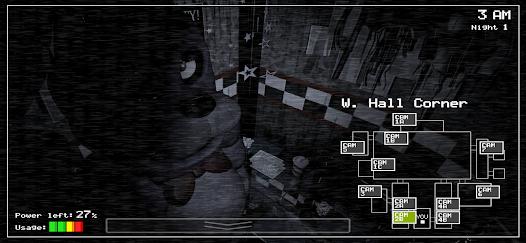
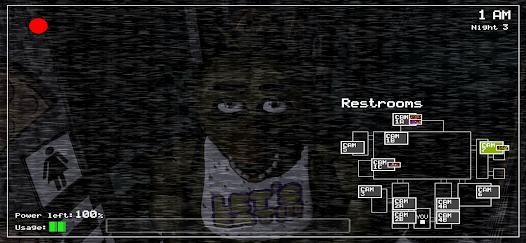
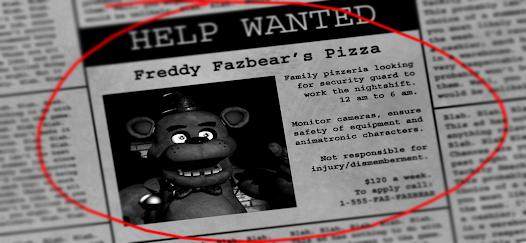
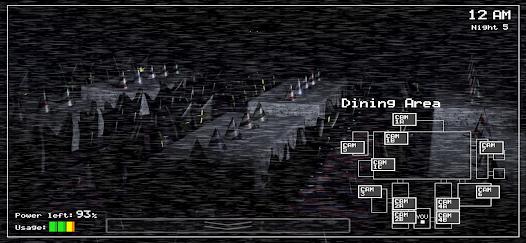
Five Nights at Freddy's, managed by Clickteam USA LLC, is a landmark achievement in modern survival horror design. Originally created by Scott Cawthon, the game leverages information denial and extreme resource scarcity to build deep physiological tension. The gameplay places players in a fixed security office from 12:00 AM to 6:00 AM, tasking them with monitoring closed-circuit television (CCTV) feeds to track a group of four hostile animatronic characters: Freddy, Bonnie, Chica, and Foxy.
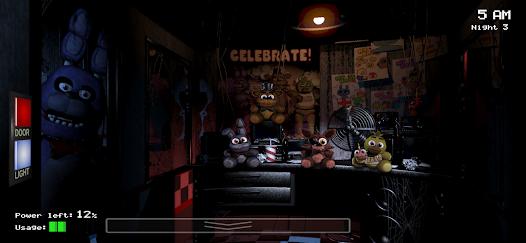
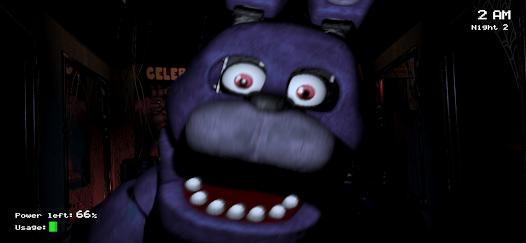
The game’s primary design masterclass lies in its conversion of safety into a rapidly depleting currency. The office features two heavy defensive doors and corresponding security lights, but operating these systems—along with checking the camera feeds—drains a limited electrical power reserve. If the power drops to zero, all defenses fail, leaving the player entirely vulnerable to a lethal jump-scare defeat. This dynamic creates a constant state of risk management, forcing players to balance sensory awareness against power consumption.
The enemy animatronics operate under distinct, rule-based artificial intelligence routines:
- Bonnie: Moves down the left side of the building, appearing abruptly at the left blind spot and requiring immediate door closure.
- Chica: Moves symmetrically down the right side, traveling through the kitchen and dining areas to ambush the right doorway.
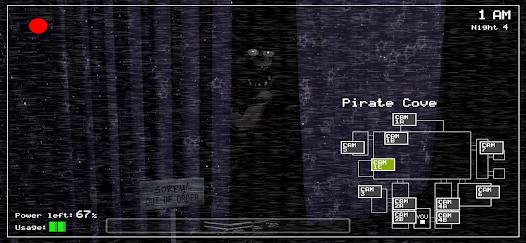
- Foxy: Resides in Pirate Cove, acting as a kinetic timer; players must monitor him regularly to prevent him from sprinting down the West Hallway.
- Freddy Fazbear: A stealth-focused, late-game predator who moves silently through the shadows, his progression signaled only by low audio cues.
The mobile port is built on the Clickteam Fusion engine, ensuring a highly faithful translation of the original game's visual assets, pre-rendered frames, and pristine audio design. It manages memory and input latency exceptionally well, delivering the instant camera transitions and responsive touch inputs critical for surviving later nights.
Pros & Cons
Masterful Dread and Tension: Low-fidelity audio cues, camera static, and claustrophobic spaces create an incredibly tense atmosphere.
Highly Strategic Resource Loop: The power-drain mechanic turns safety into a finite, carefully calculated resource.
Distinct Enemy AI Behaviors: Each animatronic's behavior requires a unique tactical response to survive.
Excellent Engine Porting: High-performance rendering via Clickteam Fusion ensures rapid camera switching and instant inputs.
Ad-Free Single-Player Experience: A true premium experience without invasive ads, paywalls, or microtransactions.
Intuitive Touch Controls: The simple layout translates point-and-click camera monitoring naturally to mobile screens.
- ✕
Diminutive UI Buttons: The door and light buttons can feel small on compact screens, occasionally leading to fatal misclicks.
- ✕
Punishing Difficulty Spikes: Later nights feature highly aggressive AI patterns that rely heavily on luck and RNG, which can frustrate players.
- ✕
Minor Visual Scaling Issues: Rapid camera switching can occasionally cause brief texture overlaps on modern widescreen aspect ratios.
Download


FAQs
How does the power management system affect survival?
Every active defense (doors, lights) and observation tool (CCTV monitor) increases power usage; running out of power disables your doors and triggers Freddy's attack.
What is the main behavioral difference between Bonnie and Chica?
Bonnie attacks strictly from the left hallway, while Chica attacks from the right, requiring players to check opposite blind spots.
Is any content missing from the original PC release?
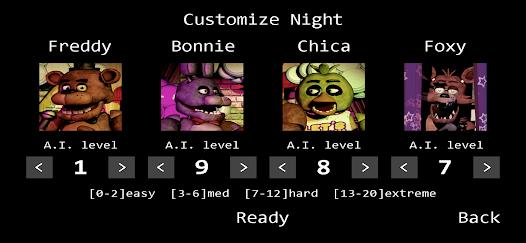
No, the port is mechanically and narratively complete, featuring all five core nights, the unlocked sixth night, and the custom night configuration menu.
How can players slow down Foxy's attacks?
Players must monitor Pirate Cove (Camera 1C) at steady intervals to delay his movement; if he has already left, the left door must be closed immediately.
Can the game be completed without audio?
No, audio cues like footsteps, laughter, and corridor hums are essential for tracking animatronics without wasting power on the monitor.
Hot Reviews
The game's atmospheric design remains unmatched, turning simple camera monitoring into an incredibly stressful and engaging horror experience.
A common issue is the tight placement of the door and light buttons, which can easily cause accidental deaths when trying to act quickly on smaller screens.
While early levels feel fair, the custom night difficulty spikes feel heavily reliant on random number generation rather than pure player skill.